
Category Archives: Information

Getting various types of information to you

Buddha’s Bookshelf

Emotions can inform us, but sometimes it feels more like they imprison us. As the great Sufi poet Rumi said they are messengers from beyond. Sometimes, however, the message is garbled or mixed. Here are books that can help us have emotions rather than emotions having us.

Working with the Emotions. Authored by Tibetan Buddhist teacher Jigme Rinpoche and edited by Sylvia Wong, this book shows us Buddhist methods for taking back control from our emotions.

Anger: Wisdom for Cooling the Flames. Buddha recognized that three mind states caused unhappiness: wrong knowing, obsessive desire, and anger. Zen Buddhist monk and Vietnam refugee Thich Nhat Hanh gives tools and advice for transforming relationships, focusing energy, and recovering from the corrosive impact of anger.

Emotional Awareness: Overcoming the Obstacles to Psychological Balance and Compassion

The Dalai Lama, one of the world’s revered spiritual leaders, and the psychologist Paul Ekman, whose work has advanced the science of emotions, examine the nature of emotions in a series of conversations. Their exploration is accompanied by commentaries on emotion research and Buddhist teachings that further contribute to our understanding of emotions.

Dharma Thought: True Freedom

This Dharma Thought on True Freedom is brought to you by Steve Allison-Bunnell from the Joining Rivers Sangha.

What is true freedom? The Declaration of Independence claims freedom from government interference and control. Over 250 years, this has morphed into a freedom from responsibility toward anyone. With this view, community and connection are hard to come by.

The Buddha offered a profoundly personal path to freedom. The Dharma offers us liberation from our own dissatisfaction with the world. Being a free person on the Eightfold Path is to live with lightness we nurture for ourselves, rather than demanding that others allow us to do as we please. What is your personal definition of freedom? When do you feel liberated?

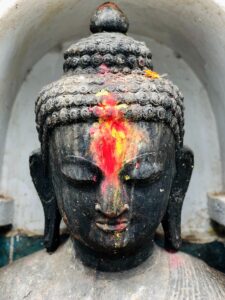
Image of head of Buddha statue to symbolize this Dharma Thought on True Freedom.

Dharma Thought: Look Up to Look Out

When I see someone walking along with their head down, eyes on the ground, I know from personal experience that they are not actually present. As a sighted person, where my gaze goes, so does my attention and awareness. So when I feel my own perception collapsing inward, turning my suffering into the singularity of a psychic black hole, I practice literally looking up and out. Where am I really? What do I see outside of myself, surrounding me? Instead of feeling alone and insignificant, touching the reality of Interbeing in the present moment — the fact that I am not separate from the rest of the universe — brings me connection and calm. What do you do when you find yourself looking down? What do you see when you look out?

This Dharma Thought is brought to you by Steve Allison-Bunnell of the Joining Rivers Sangha. Joining Rivers Sangha practices in the Plum Village Tradition of Thich Nhat Hanh and meets on Mondays at 7pm (in person only).

Silhouette of a man with hands raised in the sunset

Schedule Change: MindSpace

The MindSpace group’s schedule will change for the summer. They will meet June 27 and then start meeting every other week for July and August. Meeting dates for those months are: July 11 & 25 and August 8 &22. MindSpace is a meditation group for people 40 and younger. Group meetings begin at 6:30 PM. All welcome!

Schedule Change: July 4 Holiday

In honor of the July 4 holiday, Joining Rivers will not meet on Monday, July 3 and we will not have a Kindhearted Awareness meeting, noon sit, afternoon sit, Newcomer Orientation nor MindSpace meeting on Tuesday, July 4. Enjoy the holiday and may your dogs get through it with peace and ease.

Dharma Thought: Contemplation & Practice Suggestion

Contemplation:

Whenever we are between here and there, whenever one thing has ended and we’re waiting for the next thing to begin, whenever we’re tempted to distract ourselves or look for an escape route, we can instead let ourselves be open, curious, tentative, vulnerable.

You can always find ways to connect with this in your everyday life. Its very simple,  slow down and abruptly stop.  Look out, and touch in with the present moment.  Doing so breaks up the stream of concepts and mental chatter that overlay your experience.  It enables you to touch in with the timelessness of the present moment”.

Pema Chodron, “Welcoming the Unwelcome”

A possible practice session for the next 3 weeks:

Reflect on your motivation and aspiration.

Relax in open awareness:

       Don’t try to focus on anything in particular or control your mind.

       Leave all the sense doors open, without trying to block any aspect of experience.  

After a few minutes, bring your awareness to the physical sensations in your body

Rest your attention on an object in your visual field, or on whatever sense you have chosen to use as support for your meditation

You do not need to change or alter your experience, nor do you need to focus intensely or concentrate the mind.

                 Simply know that you are feeling/seeing/hearing.  

Rest again in open awareness, not distracted and not meditating. Eyes open for the last 1-2 min.  

This Dharma Thought is brought to you by Tergar Bozeman: The Joy of Living Practice Group which meets weekly on Wednesdays at 5:30 PM.

Dharma Thought: On Activity

On Activity, from Suzuki Roshi: “When we practice zazen, we limit our activity to the smallest extent. Just keeping the right posture and concentrating on sitting is how we express the universal nature. Then we become Buddha and express Buddha nature…we just concentrate on the activity we do in each moment. When you bow, you should just bow; when you eat, you should just eat. If you do this, the universal nature is there. In Japanese, we call it ichigyo zammai or one-act samadhi.‘ “

Despite our society’s love of “multi-tasking,” science is discovering that we really can only do one thing at a time. Our attempts at multi-tasking are actually our brains serially monotasking. This fragmented attention is the opposite of what the Buddha taught and of what Suzuki Roshi tried to remind us. Do you notice a difference in your mental state when you focus on one thing at a time and when you try to multi-task? Which one feels better?

This Dharma Thought is brought to you by the Bozeman Zen Group.

Dharma Thought: Path of Practice

“Stay on the trail!” my father would say on family hikes. It expressed his care for the land and is a strong habit for me still. So it felt oddly transgressive to be in Yellowstone this weekend, first hiking a “real” trail marked on the map, then following paths made by bison, and then just striking out cross-country to reach the road. When we were no longer on a human-made trail, we felt more vulnerable, on higher alert for bison and bears, even though the landscape was the same. But we also grew more confident in our ability to observe and navigate without a “real” trail. Life often feels the same way: anxious when we are unsure of the path; relaxed when we are. Following the path of Buddha Dharma is wonderful in two seemingly contradictory ways. As a guide, it offers tools to navigate an uncertain world. But as a practice, it also helps us tolerate uncertainty. I am grateful to take refuge in both. Are you a “stay on the trail” person? How do you experience the path of practice?

This Dharma Thought brought to you by Steve Allison-Bunnell with Joining Rivers Sangha which meets on Mondays at 7PM.

Dharma Thought: The Dharma’s Gift of a Second Chance

I hope that someday my practice will help me avoid speaking in anger more often. Until then, I take refuge in Thay’s teaching of Beginning Anew, the practice for repairing damage to a relationship. I needed to do that recently. While I still regret being unskillful to begin with, I am glad that the practice gave me the courage and confidence to make amends in an authentic, compassionate way. It took me over a week of daily contemplation, but I was finally able to write letters of sincere apology and deeper explanation for my frustration. I did not follow the precise script that Thay gives us for using within the Sangha, but the spirit of sharing, “Darling, I am suffering” was there. I was relieved when my letters were received with generosity. More than anything, it is profoundly reassuring to recover from mistakes like that, since we all will make them no matter how diligent we try to be. What fresh start would you like to make in a relationship? What do you need to Begin Anew?

This Dharma Thought is offered by Steve Allison-Bunnell with the Joining Rivers Sangha in the Plum Village Tradition.